

You’ve spent decades building it. Now let’s make sure it lasts through retirement - and beyond.
The years just before and just after retirement are the most financially consequential of your life. At Scarborough Capital Management, we manage IRA and brokerage accounts through the Fidelity and Schwab platforms, giving you access to a broad universe of investments managed by a dedicated advisor (many of whom are CFP® or CRPC® professionals) who knows your situation inside and out.
WHO IS THIS FOR
Approaching or recently retired
Assets in IRAs, rollover IRAs, or brokerage accounts
Looking for a dedicated advisor
Navigating rollover, SS, pension, or income decisions
Aiming for a protection-first approach
WHAT’S INCLUDED
Comprehensive financial plan from a dedicated advisor
Investment management on Fidelity or Schwab
Retirement income planning (tax-efficient withdrawals)
Social Security & pension analysis
Estate planning best practices & tax-aware strategies
Unlimited phone and email advisor access
Our Approach: Protect First, Grow Second
We aim to take a conservative, evidence-based approach. We build diversified portfolios designed to hold up through market cycles — because the closer you are to retirement, the less room you have to recover from a major loss. We strive to explain everything in plain English.
HOW IT WORKS
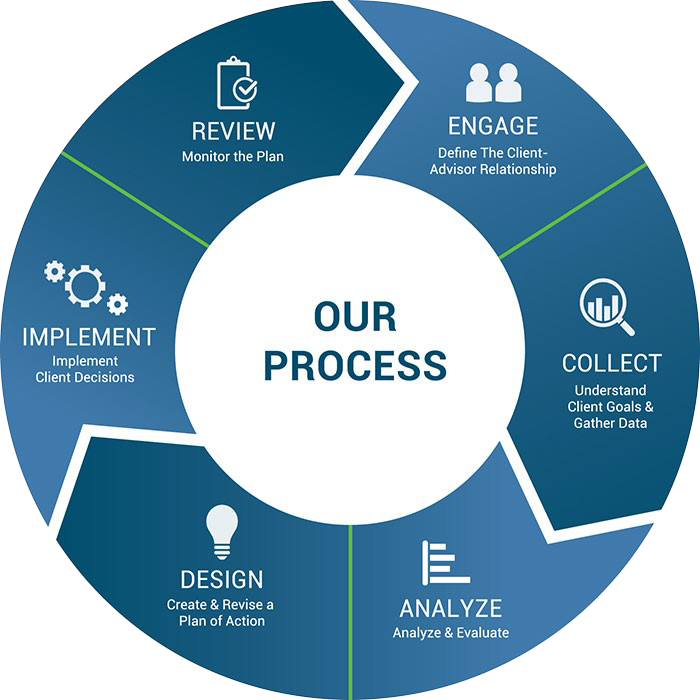
- We listen first: your goals, concerns, timeline, and current situation.
- You receive a comprehensive financial plan covering topics like investments, taxes, Social Security, estate planning best practices, and more.
- Your plan is stress-tested against various market scenarios.
- We implement your strategy and begin actively managing your portfolio.
- We stay in regular contact with ongoing reviews and are always available by phone or email.
What The First Ninety Days Might Look Like
Every plan and everyone’s path is a little different, but people are often surprised by how much of the early work is listening rather than investing. Here’s what the sequence often shapes up to be.
WEEKS ONE AND TWO — We Get The Full Picture
Every account, not just the ones you’d move to us. Pensions, Social Security estimates, real estate, insurance, what you owe and to whom. We ask what you actually want retirement to look like, which is a harder question than most people expect, and we ask what worries you at two in the morning. That last answer usually shapes the plan more than any spreadsheet might.
WEEKS THREE THROUGH SIX — The Plan
You receive a written financial plan covering topics such as investments, retirement income, taxes, Social Security timing, healthcare expenses in retirement, and estate planning best practices. We aim to stress-test plans against a range of market scenarios, including a poor one arriving early. Generally, if the plan only works when markets cooperate, it isn’t a plan.
WEEKS SIX THROUGH TWELVE — Implementation
We open accounts at Fidelity or Schwab, coordinate transfers, and put the strategy in place. Transfers typically only take a week or two depending on the custodian you’re leaving. You keep full online access throughout, and nothing moves without your authorization.
AFTER THAT — The Ongoing Part
Regular reviews, rebalancing as markets move, and a phone number that reaches a person who knows your situation. Most clients hear from us several times a year, more when something is happening. You can call whenever you like; there’s no meter running.
How We Invest
We build diversified portfolios using the principles of asset allocation, drawing on third-party research alongside our own. Portfolios typically hold mutual funds and exchange-traded funds, with individual securities if a client’s situation calls for it.
What we don’t do matters too. We don’t aim to try to time the market, we don’t aim to chase last year’s winners, and we don’t aim to build a portfolio you couldn’t explain to your spouse. The closer you are to needing the money, the less room there typically is to recover from a serious loss — so the strategy usually gets more deliberate, not more adventurous, as retirement approaches.
Investing involves risk, including possible loss of principal, and no strategy can eliminate that. What a strategy can do is help to make sure the risk you’re taking is the risk you actually meant to take.
What Happens When The Market Drops
It will. The question is what it does to you when it does.
A significant decline in the first few years of retirement can do more lasting damage than the same decline ten years later, because you’re selling shares at depressed prices to fund living expenses and there are fewer shares left to participate in the recovery. This is sequence-of-returns risk, and it’s the reason two retirees with identical average returns can end up in very different places.
We aim to address it in three ways: keeping near-term spending needs in more stable assets so you’re less likely to be forced to sell equities at the wrong moment, structuring withdrawals to draw from different places depending on conditions, and — the part people underestimate — having a plan already written down so the decision isn’t being made in the middle of a bad week.
WHAT’S YOUR RISK NUMBER?
Most people have a rough sense of how much investment risk they’re comfortable with, and a portfolio that doesn’t quite match it. The gap usually only becomes obvious in a difficult market, which tends to be the worst time to find out.
This short questionnaire produces a risk number between 1 and 99 — a way of putting a figure on your comfort level. It takes about five minutes, and there’s no cost or obligation.
The questionnaire is provided by Nitrogen and opens in a new tab.
Taxes:
The Part Most People Underestimate
For most of your working life, taxes were largely handled for you. In retirement they tend to become an active decision, several times a year.
The years between retiring and the start of required minimum distributions are often among the most flexible tax years you’ll have — income is generally lower, and you may have unusual control over what shows up on your return. That window is where a lot of the value can sit: partial Roth conversions, realizing gains at favorable rates, or simply drawing from taxable accounts before touching tax-deferred ones.
Required minimum distributions generally begin at 73, or 75 depending on your birth year, and they arrive whether you need the money or not. Planning for them years ahead is usually easier than reacting to them. For charitably inclined clients over 70½, qualified charitable distributions may satisfy part of an RMD without the distribution appearing in taxable income.
We don’t prepare tax returns or provide tax advice, but we can work alongside your tax professional to help streamline communication. After all, it’s not uncommon that investment decisions and their tax consequences are really two sides of the same decision, and treating them separately might otherwise cost you.
What You’ll Pay, And What You Won’t
Our wealth management fee is approximately 1% of assets under management per year, billed quarterly. For a $500,000 portfolio, that’s roughly $5,000 a year. Our fee schedule is tiered by asset level and is set out in full on our Our Fees page and in our Form ADV Part 2A.
There are no setup fees and no termination fees. We are generally compensated by that advisory fee only. Mutual funds and ETFs carry their own internal expenses, and custodians may charge transaction fees — those are disclosed in each fund’s prospectus and by the custodian, and they are separate from what we charge.
The financial plan, the Social Security analysis, the pension analysis and the ongoing advice are all included. You won’t get a separate invoice for calling your advisor.
FREQUENTLY ASKED QUESTIONS ABOUT WEALTH MANAGEMENT
Our wealth management fee is approximately 1% of assets under management per year, billed quarterly. For a $500,000 portfolio, that’s approximately $5,000 per year. See Our Fees page.
We manage client assets on both the Fidelity and Schwab platforms. Both provide broad investment access, strong custody, and full online account visibility so you can always see your holdings and activity.
In most cases, we can initiate an in-kind transfer or rollover into a Scarborough managed account on Fidelity or Schwab. We handle the paperwork and coordination.
This is one of the most important risks we aim to plan for — it’s called sequence-of-returns risk. Your plan should include strategies to help protect against a downturn in early retirement, including appropriate cash reserves and a thoughtful drawdown sequence.
Your advisor proactively schedules regular reviews and is reachable by phone or email whenever you need them. You won’t wait days for a callback.
Yes — this is one of the most common ways new clients come to us. See our dedicated 401(k) Rollover to IRA page for details.
There’s no formal minimum. In practice, wealth management tends to make sense once you have meaningful assets outside a workplace plan — often after a rollover at retirement.
If you’re not there yet, our subscription plan management services may be the better fit, and we’ll say so. At some large firms you need $250,000 or more simply to speak with an advisor. That’s not how we work.
Your accounts stay with the firm and another advisor takes over, with a proper handover rather than a cold start. Our five Managing Partners have been with the firm for decades, and several of our advisors have been here twenty years or more.
It’s a fair question to ask any firm you’re considering, and the answer tends to say a lot about how it’s built.
Usually, and we’d generally encourage it. Retirement planning tends to be a household exercise — Social Security claiming decisions, withdrawal sequencing, and survivor planning often depend on both people’s situations. Planning one in isolation can produce a worse answer for both.
A robo-advisor allocates a portfolio using an algorithm, generally at a lower cost than a human adviser. For a straightforward accumulation account, that can be perfectly adequate.
The differences tend to show up in the decisions that aren’t purely about allocation: when to claim Social Security, whether to take a pension as a lump sum, which account to draw from in a year your income spiked, whether to convert to a Roth before RMDs begin, and what to do when you’re anxious in a falling market. Those are conversations rather than calculations.
Plenty of people talk to us for a second opinion and stay where they are. That’s a legitimate outcome and we won’t pressure you away from it.
The questions worth asking your current advisor: what am I paying in total, are you a fiduciary and in what capacity, and when did we last review my plan rather than my portfolio. If the answers are good, that’s genuinely useful to know.
Yes. We’re based in Annapolis and serve clients across the country — we’re registered to offer securities in 47 states and the District of Columbia. Most client meetings happen by phone or video, and have for years.

HOW TO BECOME A 401(K) MILLIONAIRE

9 WAYS RETIREES CAN EARN EXTRA INCOME

WHAT TO KNOW TO PROTECT YOUR WEALTH

Let’s talk about your retirement plan.
Schedule a free, no-obligation 30-minute consultation. We’ll review where you are and walk you through what a personalized wealth management plan might look like for you.
"*" indicates required fields